What actually happened
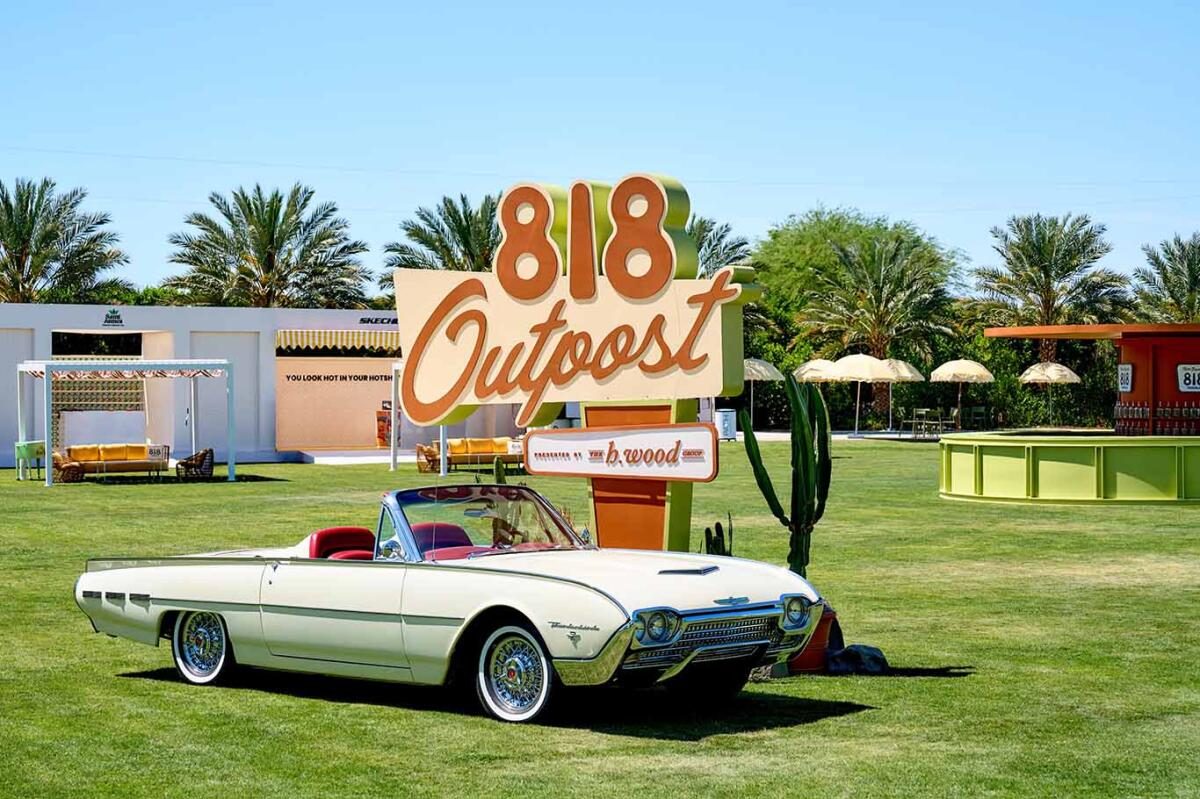
On Friday 10 April 2026, 818 Tequila, the brand founded by Kendall Jenner, opened the 818 Outpost in the Coachella Valley for its fourth year. It was invitation only, 21+, and it ran for an afternoon, with a headlining set from KAYTRANADA and a bar built around the brand’s own bottles.
The design leaned all the way into mid-century Googie architecture and space-age retrofuturism: live performers, photo booths, a tequila bar and heavily art-directed spatial design. It also wasn’t a solo build. 818 filled the site with partners (Rhode, Khloud, Lemme and Blank Street) while Postmates ran the “Pit Stop,” an immersive food garden with trucks from Ggiata, Heavy Handed and HomeState. Salt & Stone used the Outpost to debut Amber & Agave, a limited body care collection built around the scent notes of 818 Añejo, with a mini trio set at $38 and a candle at $49.
Access was closed, with a limited number of passes released through a giveaway on the brand’s own Instagram.
The numbers
Across Coachella-tagged content from 9–12 April, 818 was the most-mentioned brand of the weekend, according to creator-marketing measurement of the festival: 290 creators, 536 posts, 2.2 million engagements at a 5% engagement rate, and 32 million video views.
The number that matters there isn’t 32 million. It’s the 5%. Reach at that volume is usually bought and usually inert; a 5% engagement rate says the posts were being watched by people who cared, not served to people who scrolled.
Why it worked
- The guest list was the media buy. An open activation optimises for footfall. A closed one optimises for who. 290 creators posting once each is a bigger distribution event than 20,000 attendees who mostly don’t.
- Exclusivity manufactured the story. A party anyone can attend generates photos. A party you can’t generates commentary, from the people inside and, just as usefully, from the people outside. The Instagram pass giveaway turned that shut door into a reason to follow the account.
- The partner stack multiplied the reach. Rhode, Lemme, Khloud, Blank Street, Postmates, Salt & Stone: every one of those brands had its own audience, its own creators and its own reason to post. 818 didn’t pay for that reach. It hosted it.
- A product launch gave press a peg. Amber & Agave meant the Outpost wasn’t only “a good party.” It was where something debuted. That’s the difference between coverage and a mention.
- A committed art direction. Googie and retrofuturism is a specific, weird, wholly coherent choice. Specific photographs well. “Elevated desert” does not.
An open activation counts the people who came. A closed one counts the people who heard.
What it was actually worth
At the end of April 2026, 818 announced a strategic partnership with Sazerac, taking an undisclosed investment along with exclusive US distribution. By June it was running “Best Summer Ever,” a fifth-anniversary campaign and its first major push under the new deal, built around a sweepstakes giving consumers the chance to win $8,180 through the summer.
That sequence is the real lesson. The Outpost wasn’t the marketing budget being spent; it was the cultural position being built, and cultural position is what a distributor buys. Four years of showing up in the same place at the same time is an asset on a balance sheet.
The part worth being honest about
Celebrity-founded tequila is contested ground, and 818 has drawn criticism since launch over its campaign imagery and its relationship to the region and the people who actually make the category. Heat is not the same as goodwill. If you’re borrowing this playbook, the exclusivity is the easy half; earning the right to the culture you’re drawing from is the hard half, and it doesn’t happen at the party.
What your brand can borrow
You almost certainly can’t book KAYTRANADA. You can absolutely run the structure: one afternoon, one room, a tightly-drawn invite list of people who make things, three or four partner brands sharing the cost and the audience, one thing that launches there and nowhere else, and an art direction specific enough to be recognised in a grid.
Then repeat it on the same weekend next year. Most of 818’s advantage in 2026 came from it being the fourth one. If you want the step-by-step version, start with our activation planning framework, or see the same scarcity logic at smaller scale in the Rhode playbook.
The takeaway: stop optimising for how many people get in. Start optimising for who does, and for what they take with them when they leave.
Invite-only builds, partner-funded activations and festival-adjacent moments are core to what we do at Storyboard. If you’re planning one, tell us about it.